20 Minute Timer for Screen Work: The 20-20-20 Rule
Drifta is an iPhone task app for ADHD that gives every task its own time window.
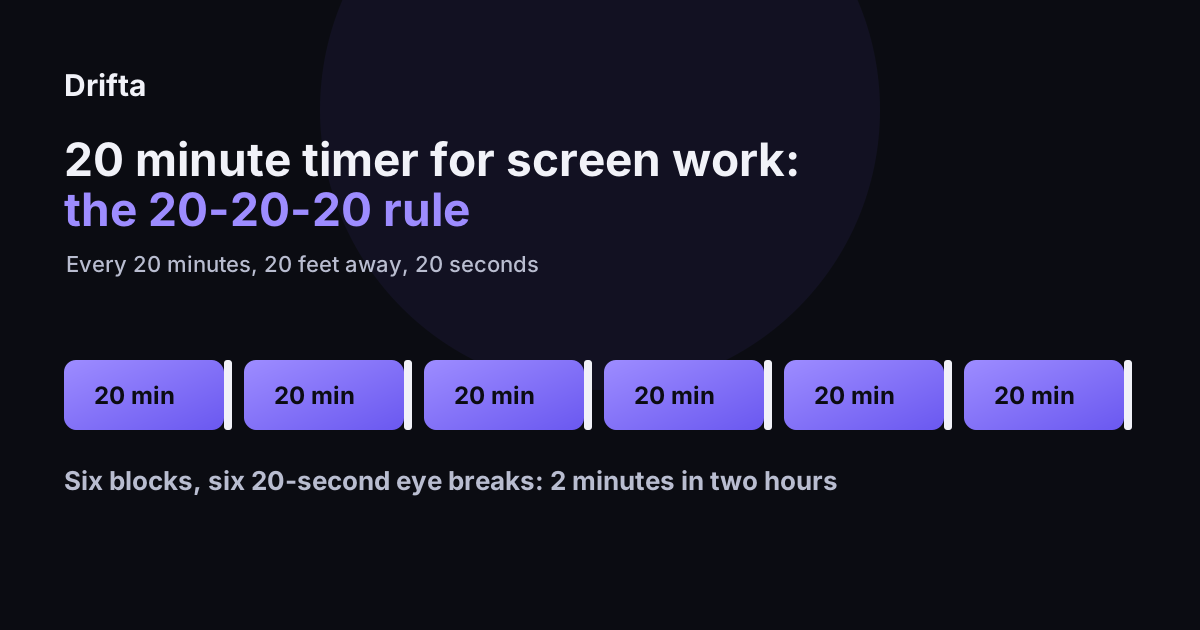
A 20 minute timer is the usual trigger for the 20-20-20 rule, which the American Academy of Ophthalmology states as: every 20 minutes, look at something at least 20 feet away for at least 20 seconds. The break is 20 seconds long, so the timer should interrupt your gaze and leave your task open.
A 20 minute timer is the usual way to follow the 20-20-20 rule for screen work. The American Academy of Ophthalmology (AAO) states the rule like this: "Every 20 minutes, shift your eyes to look at an object at least 20 feet away, for at least 20 seconds." The break lasts 20 seconds, so the timer only needs to pull your eyes away and leave the task where it was.
What is the 20-20-20 rule and who recommends it?
The 20-20-20 rule is a screen-break habit the AAO recommends in its guidance on eye strain: every 20 minutes, look at something at least 20 feet away for at least 20 seconds. The AAO's eye-strain page includes it as a closing reminder after advice on screen position and computer glasses.
The same page explains the setup around it. It describes a typical screen distance of roughly 20 to 26 inches, so an object across the room gives your eyes a much farther target. Take the numbers as a rule of thumb. The AAO page gives it as advice with no trial attached, so nothing here claims how much it helps any one person.
Why does a 20 minute timer work better than remembering?
A 20 minute timer works better than remembering because absorbed work hides the clock. Deep in a spreadsheet, 20 minutes passes with no sign at all. That is the same mechanism described in what time blindness feels like with ADHD: the gap between felt time and clock time is large exactly when attention is locked in.
A timer fixes that by watching the clock for you. Start it before the work, label it "look away," and the 20 minutes no longer depend on your attention.
How much time do 20-second breaks actually cost?
The 20-second breaks in a two-hour screen task cost two minutes in total. Two hours is 120 minutes, and 120 / 20 = 6 breaks. Six breaks at 20 seconds each is 6 x 20 = 120 seconds, which is 2 minutes.
| Block | Clock time (start 9:00) | Eye break | Running break total |
|---|---|---|---|
| 1 | 9:00 to 9:20 | 20 seconds | 0:20 |
| 2 | 9:20 to 9:40 | 20 seconds | 0:40 |
| 3 | 9:40 to 10:00 | 20 seconds | 1:00 |
| 4 | 10:00 to 10:20 | 20 seconds | 1:20 |
| 5 | 10:20 to 10:40 | 20 seconds | 1:40 |
| 6 | 10:40 to 11:00 | 20 seconds | 2:00 |
Two minutes in two hours is a poor thing to save by skipping a break. You can keep your hand on the mouse the whole time. The hard part is remembering to look up, and that is the timer's job.
How do you take the break without losing your place?
You take a 20-second break without losing your place by finishing the sentence or line you are on, then leaving a visible marker. A half-typed formula or a highlighted row works. When your eyes return, the marker shows the next move without any thinking.
Keep the break tiny. You only need to change how far your eyes are focusing, so stand up only if you want to. A window across the room or a wall at the far end of a hallway is often 20 feet or more. The AAO wording says "at least," so a farther object is fine.
If the timer rings mid-thought and you want a full stop instead, that is a different problem. The post on what to do when a 20-minute block ends mid-task covers when to extend, pause, or stop.
Should the 20 minutes also be a work block?
A 20 minute timer can double as a work block, but the eye rule alone does not require it. Stopping every 20 minutes to check progress suits some people, and others lose momentum. Compare formats in work timers compared, and try a one-week trial of each before settling.
If you are using the timer for starting a task you have avoided, 20 minutes is long. Start with five, then add the eye break only once you are in motion.
Can Drifta run a 20 minute timer?
Drifta's focus timer can run 20 minutes on Pro. The product page says: "When starting is the hard part, run a short focus timer. Pro adds 10 to 60 minute sessions." Free sessions run up to five minutes, so a free account needs the Clock app for a 20-minute countdown.
Use the table if you want reminders at fixed clock times. If you restart a 20-minute Pro timer after every look-away, each reminder falls 20 seconds later than the fixed schedule for each break already taken. Nothing in the product source shows that Drifta prompts an eye break, so the look-away stays your decision.
Common questions
What is the 20-20-20 rule?
Every 20 minutes, shift your eyes to an object at least 20 feet away for at least 20 seconds. The American Academy of Ophthalmology lists it as a way to ease eye strain from screen work.
Should a 20 minute timer end my work session?
Not for the 20-20-20 rule. The break lasts 20 seconds, so you look away, then keep working. If you want to stop the task itself every 20 minutes, that is a separate choice about work blocks.
How many 20 second breaks fit in a two-hour screen task?
Six. Two hours is 120 minutes, and 120 divided by 20 is 6 breaks. At 20 seconds each, the breaks cost 120 seconds, or two minutes of the two hours.
Does Drifta have a 20 minute timer?
Drifta's focus timer lengths of 10 to 60 minutes are a Pro feature, so 20 minutes is available on Pro. Free sessions run up to five minutes.
This article shares practical organizing ideas. It is not medical advice. For diagnosis or treatment questions, talk with a qualified clinician.