Two-Minute Rule vs. a 5 Minute Timer: Which Start Fits
Drifta is an iPhone task app for ADHD that gives every task its own time window.
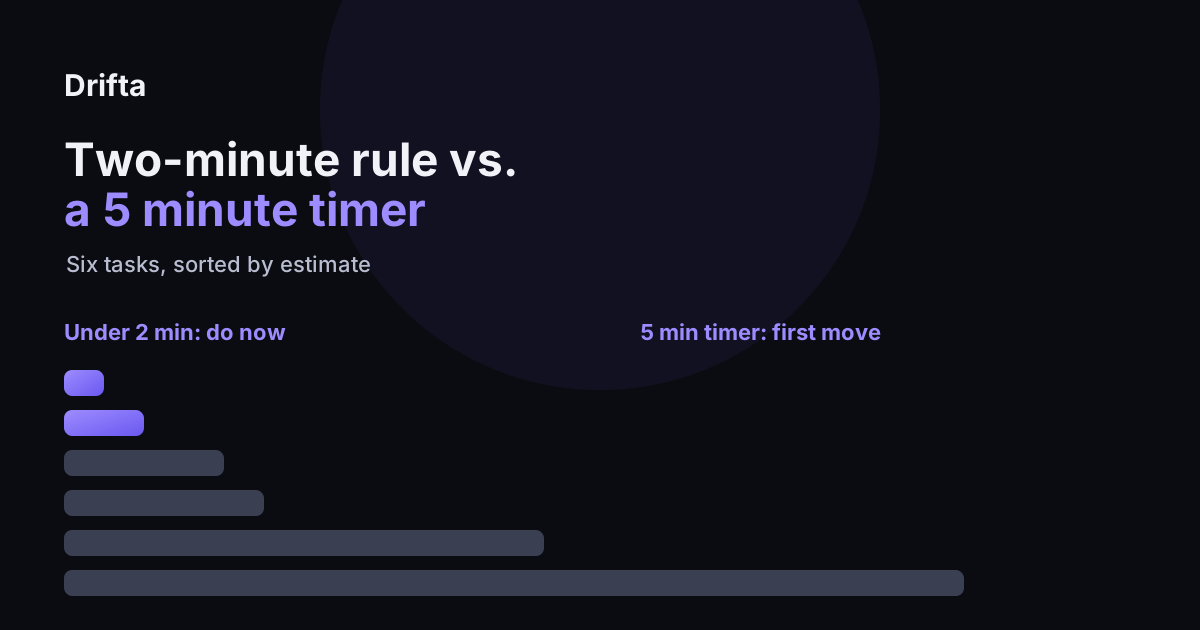
Use the two-minute rule for tasks you can finish in under two minutes and a 5 minute timer for tasks that need a first move. David Allen's rule says to do anything under two minutes right away. Anything longer, or anything with an unknown size, gets five minutes on a timer, then a written next step.
Use the two-minute rule for tasks you can finish in under two minutes, and a 5 minute timer for tasks that need a first move. The rule comes from David Allen's Getting Things Done method, and it says to do small things now instead of writing them down. A five-minute timer picks up where the rule stops: the task is bigger, or you do not know how big it is.
What does the two-minute rule actually say?
The two-minute rule says that a task you can complete in under two minutes should be done immediately. On the Getting Things Done site, David Allen states it as: "Anything you can do in less than two minutes, if you need to do it at all then do it right then." The practical effect is that tiny tasks never reach your list.
The rule is silent about everything past two minutes. Stuck tasks live in that gap: the form that might take twelve minutes, the call that depends on someone picking up, the document nobody has opened. A rule built for quick wins does not tell you how to begin something of unknown size.
What is a 5 minute timer good for that the rule is not?
A 5 minute timer is good for beginning tasks the two-minute rule cannot finish, because it fixes the commitment at five minutes whatever the task size. The promise is small: open the task, touch it, and write down what comes next. Finishing is optional.
The existing guide to the five minute start covers why a short boundary lowers the cost of beginning. A separate post tests whether five minutes is enough on one stuck form. This post handles the earlier question: which of your tasks should get the timer at all.
How do you sort a task list between the two?
Sort a task list by estimating each task in minutes, then applying three cutoffs: under two minutes, do it now; two to five minutes, run a timer; over five minutes or unknown, run a timer for the first step only. The estimate can be rough. If you consistently guess low, a simple way to estimate tasks helps.
Here is a made-up list of six tasks with guessed estimates, so you can repeat the sorting with your own numbers.
| Task | Estimate | Start it gets | Minutes spent |
|---|---|---|---|
| Reply "yes" to the school form email | 1 min | Two-minute rule, do now | 1 |
| Add the dentist date to your calendar | 2 min | 5 minute timer, finish it | 2 |
| Call the pharmacy about the refill | 4 min | 5 minute timer, finish it | 4 |
| Pay the water bill | 5 min | 5 minute timer, finish it | 5 |
| Fill in the expense form | 12 min | 5 minute timer, first step | 5 |
| Clear the junk drawer | 30 min | 5 minute timer, first step | 5 |
The total is 1 + 2 + 4 + 5 + 5 + 5 = 22 minutes, and all six tasks have moved. The one-minute reply is done immediately. Three tasks finish in eleven minutes across their timer blocks, and two have a first step done and a note about the next one. The expense form and the drawer are still open, which is the point: the sort protects you from planning thirty minutes you will not start.
What should you write when the five minutes end?
When a 5 minute timer ends, write the next step on the task before you do anything else. Use a physical, specific line: "Scan receipts 3 and 4, then enter totals," not "continue expense form." A note like that turns the second start into a ten-second decision.
The task from the five minute task you have avoided for three weeks shows the failure mode this prevents. The task looked small, hid a missing input, and kept being postponed. A named blocker beats a vague "later."
Where does the two-minute rule break down?
The two-minute rule breaks down when it becomes a way to stay busy. The rule sets a cutoff for what to track, and it was never a goal to maximize. If you clear twenty tiny items and the expense form never moves, the rule worked as written and the list failed you.
That is why the sort above reserves a timer slot for the big items. Do the quick tasks first if you like. Give the stuck ones their five minutes before the day shrinks.
How does this work with Drifta's free focus timer?
Drifta's free plan fits this method closely, because its focus timer runs up to five minutes. The product page says: "Yes. Up to 10 daily tasks, Up Next and Backlog lists, time windows, quiet hours, three voice captures, and a five-minute focus timer."
The math is direct. Ten daily tasks with one five-minute start each is 10 x 5 = 50 minutes, so a full free day of first moves fits in under an hour. That figure counts the timer only. It says nothing about how long finishing the tasks takes, and no source here shows that five-minute starts finish tasks.
Common questions
What is the two-minute rule?
David Allen's Getting Things Done rule says that if a task takes less than two minutes, you do it right then instead of tracking it. His site words it as "Anything you can do in less than two minutes, if you need to do it at all then do it right then."
When is a 5 minute timer better than the two-minute rule?
Use the timer when a task is larger than two minutes, when its size is unknown, or when starting is the obstacle. The timer limits the commitment to five minutes and ends with a saved next step rather than a finished task.
Can I use both on one task list?
Yes, and the sorting takes about a minute. Estimate each task, do the ones under two minutes immediately, put five-minute timers on the next group, and give anything bigger a five-minute first step.
How many five-minute starts can the free version of Drifta hold?
The free plan allows up to 10 daily tasks and a five-minute focus timer. Ten tasks with one five-minute start each is 10 x 5 = 50 minutes, which is the most a full free day of first moves can take.
This article shares practical organizing ideas. It is not medical advice. For diagnosis or treatment questions, talk with a qualified clinician.